














You walk in, and something immediately feels different.
FZN — pronounced like Frantzén, shortened — isn’t a restaurant you casually walk into. The door closes behind you and, just like that, Dubai fades away. The noise, the pace, the outside world all disappear. What replaces it is calm, focus, and a sense that you’ve just stepped into another dimension.
This is not a dining room. It’s an experience designed in chapters.
Inspired by Björn Frantzén’s iconic restaurants in Stockholm and Singapore — both holding three Michelin stars — FZN brings that same philosophy to Dubai: modern European fine dining shaped by Nordic discipline and Japanese precision. And while many are already whispering about Michelin and whether this could become Dubai’s first three-star restaurant, what matters most is that everything here feels intentional, confident, and quietly exceptional.
The evening doesn’t start at a table. It starts upstairs, in what feels like a Nordic living room. Soft lighting, warm materials, curated music, and a team that already knows who you are. Families, couples, travelers from all over the world — everyone is welcomed the same way, with ease and genuine warmth.
The first bites arrive as small introductions to the philosophy behind FZN.
A French-style choux pastry appears first, but this isn’t dessert. The pastry is filled with a rich, warm cheese sauce built around Comté, creamy and comforting, instantly setting the tone. Next comes a celery-root taco, where the shell itself is made from celeriac and filled with sweet langoustine claws, dressed with finger lime and orange. Fresh, crisp, and bright, it disappears in one bite.
Then comes a moment that defines the kitchen’s confidence: a buckwheat blini hiding a layer of yuzu kosho butter and horseradish crème fraîche, topped with otoro, the fattiest and most luxurious cut of tuna belly. Grated wasabi and aromatic oils finish it off. Fat, heat, acidity, and umami — all perfectly balanced in a single mouthful.
Another bite follows, called a “spring impression.” A delicate yuba shell holds smoked ricotta cream, a salad built around asparagus, pumpkin seeds, and a subtle touch of garam masala. It’s light, aromatic, and quietly complex, showing how far this kitchen is willing to go without ever losing restraint.
Then you move.
You’re guided downstairs, closer to the heart of the restaurant, where the kitchen becomes part of the experience. You sit near the fire, watching a multinational team work in complete harmony. No shouting, no chaos. Just calm precision. Swedish birchwood burns steadily, embers glow, and every movement feels purposeful.
Before the next courses, the team walks you through the ingredients. Scallops from northern Norway. Langoustines from the coast of Bergen. Turbot from Brittany, dry-aged for up to ten days. Caviar developed in collaboration with N25 and Frantzén, raised on clear mountain water and aged in Munich. Danish organic eggs. French guinea fowl. Nordic berries you’ve probably never seen before. Preservation, fermentation, drying — all rooted in Nordic tradition.
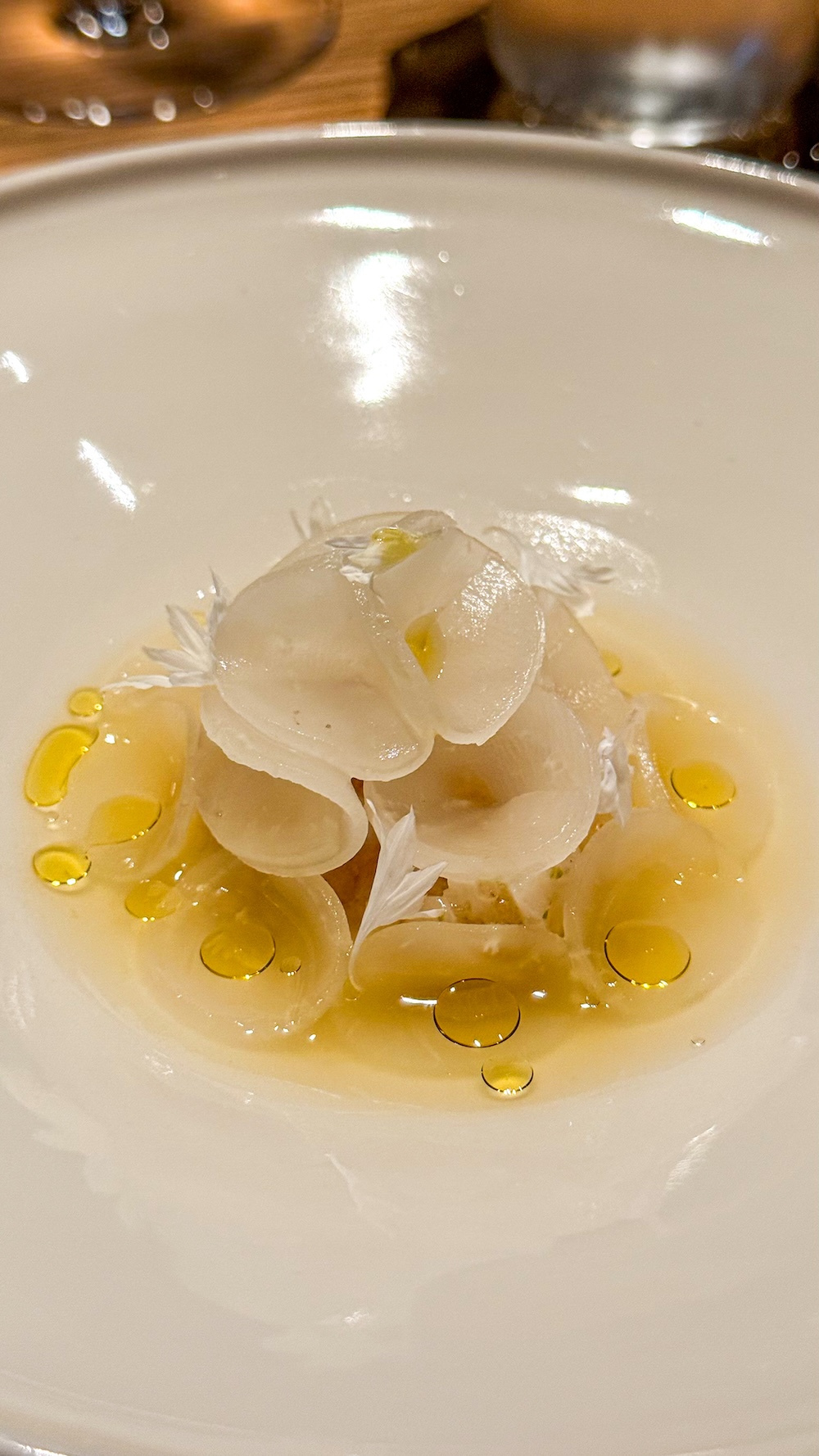
The first plated dish arrives: raw Norwegian scallop dressed with fermented and dehydrated apricot, Japanese snowball turnips, tomato water, and orange blossom oil. Clean, floral, lightly acidic, with a delicate crunch. It’s refreshing, elegant, and instantly memorable.
The langoustine that follows is meant to be eaten with your hands. Coated in a crisp layer made from dried koshihikari rice, fried just long enough to create texture while keeping the inside juicy, it’s served with a double-layer sauce — a tomato base touched with turmeric, topped with a butter emulsion. Salty, rich, and deeply satisfying. Rose water arrives afterward, not to drink, but to clean your hands. A small detail that says everything about the level of care here.
Then comes chawanmushi — Japanese steamed egg custard — elevated into something entirely new. Silky and warm, layered with a broth made from aged and smoked beef, grilled razor clams, sea urchin, and coriander. You’re told to spoon all the way down, and when you do, every layer comes together. Comforting, oceanic, and refined.
The turbot is a standout. Poached gently in a butter bath, topped with caviar, and served with a sauce that blends Nordic and Middle Eastern influences — Swedish vinegar, tahini, sprouted walnuts, brown butter, and walnut oil. The fish is impossibly clean, rich without heaviness, melting softly on the tongue. No tricks, no theatrics. Just mastery.
A “French toast” follows, though nothing about it is breakfast. Spelt sourdough grilled, topped with a spring onion emulsion, Japanese blue mussels grilled over open fire and dusted with sumac, finished with house-made, charcuterie-style Angus beef. Salty, smoky, soft, intense. A signature bite that makes you pause and smile.
One of Björn Frantzén’s most famous flavor combinations arrives next: onion, licorice, and almond, served as a soup. Caramelized onion purée, onion broth, roasted marcona almonds, licorice powder, almond oil. Savory and sweet at the same time, familiar and completely new. It confuses the brain in the best way possible.
The main course is French guinea fowl, cooked over birch embers, rosé and tender with crisp skin. Morel mushrooms stuffed with guinea fowl farce, wild garlic emulsion, local mint, and a perigord truffle sauce complete the plate. And then there’s the bread — a soft milk roll served with nine layers of butter, including shallot and truffle butter. This isn’t a side; it’s your spoon. You wipe the plate clean, happily.
Desserts continue the journey rather than simply ending it.
A palate cleanser built around lingonberry, spruce soil, crystallized violet, black currant granita, rose powder, and balsamic vinegar refreshes everything. Then comes the cloudberry dessert — rare Nordic berries served with pistachios, matcha, Earl Grey mousse, milky oolong tea, and a surprisingly perfect salted carrot ice cream. Strange on paper, unforgettable in reality.
The experience closes upstairs again, back in the lounge, with Japanese fruits treated like jewels: crown musk melon, strawberries finished with tonka bean and long pepper, Miyazaki mango with yuzu zest. Petit fours follow — macaroons, chocolates, a secret box that feels like a final wink from the kitchen.
FZN is not about show. There’s no gold leaf, no unnecessary smoke, no forced drama. It’s about ingredients, technique, flow, and hospitality. About making you feel part of something rare.
This isn’t just one of the best fine dining restaurants in Dubai. It’s a restaurant that belongs on a global stage — the kind of place people travel for.
And now I understand why everyone’s talking.
To watch it live and raw: